Showing posts with label stock market. Show all posts
Why is money management important for your trading?

Why is money management important for your trading?

 Why-is-money-management-important-for-your-trading

When you think about trading, the first thing that comes to your mind is money. There are tonnes of questions that arise in your mind which definitely involve money – how much money should you invest? How much time should you take to expand your investment profit? Which are the shares you would make the most money in? However, you tend to overlook an important aspect – your money management technique. This aspect is one of the most crucial factors in establishing a flourishing trading profession.

Blending the money management technique with a strong marketing strategy would make a formula for robust long-term sustainability in the field of trading. Another tip to keep in mind is to alienate yourself emotionally from trading. Make sure to build a trading system based on confidence and a stress-free environment. So, before we dive in to learn about some of the essential tips and techniques that can come in handy to help you manage your money – let us understand what exactly money management is?

What is Money Management? 

What-is-Money-Management

Money Management is the skill of controlling capital by utilizing secure capital risk management. Apart from trading psychology, you need to keep an eye on money management. Freshers in trading often ignore it and run behind only profits and technical interpretation. It is essential to remind yourself repeatedly in the stock market to keep an eye on other traders. In addition to this, competing against other traders requires knowing yourself, your financial statement, and your capital risks.

Why do you need Money Management Technique?

Why-do-you-need-Money-Management-Technique

Trading begins with discipline and keeping your impulsive emotions in check. Money management techniques further complement this step by helping you decide the amount of money you should invest in trading, cutting your losses, and fixing the time when you should step away with the money still in your account. If you wish to be in the trading system for the long term, you should overview the capital risk involved. It is also essential to consider the pros and cons of the techniques you are choosing – some methods would help in your growth, and some would help manage the risks.

It would also be best if you were sure about your purpose, as it would help you decide on entering or exiting a trade – further complicating your chances of evaluating discipline. Although holding a money management system in place demands the merchant to be disciplined and adhere to it, estimating its effectiveness is also required.

Once you have set the path to your strategy and have followed it for a specific period, you should invest in a stock. You should assess the loss you have incurred and the profits achieved. Assess the strategy in blend with an overall summary of your dealing plan in general. Generally, slow and steady is the most suitable course for freshers.

Over time, they can adjust the technique to provide more extensive trade sizes and more substantial withdrawals as earnings multiply. Even if a tradesperson has exceptional professional or structural interpretation abilities and can generate an 80%-success valuation on stocks, unintended failures from the lack of choosing a money management technique can cause a loss of 20% of trades to clear out the player’s account. An investment of time and effort in vital money management skills can hold a dealer profitable even if the chances of winning are 50%. Management of your money should always be refining and growing.

What type of trader are you?

What-type-of-trader-are-you

Before investing your time, money, and effort in a technique, you need to ask yourself which category you fit in? Every person is different, and so there is a difference in trading psychology as well. It would be best if you approached the business with a technique that suits your personality. So, are you the conservative one wishing for stable returns and taking low risks? Or are you the aggressive one wanting higher geometric growth and taking high risks? Depending on the answer to this question, you can dive into the investment – the greater the risk you take, the more are the chances of your potential return.

Different Techniques for Money Management.

You can focus on several elements to increase the efficiency of your money management system when trading. Keep reading about a few of the most extensively practiced ones.

Martingale

Martingale

The trading system you choose should empower you to begin at a modest rate and develop significantly, merely that it needs progressing position areas while you are in a failing streak. The Martingale technique is adopted by high-risk traders who are willing to increase the money invested when they start losing – highly relying on doubling up the failing bets. If the doubled chance is also a loss, the method redoubles the risk, and it goes on. It’s principally based on the player’s inconsistency; it can work only for long-term professional players who already have plenty of capital with them.

Reverse-Martingale

Reverse-Martingale

This method is the complete opposite of Martingale’s technique. Keeping the new profits or losses in mind, a trader needs to modify the invested position areas’ size, raising the risk when profiting and lowering it when failing. Most of the money management systems use the Reverse-Martingale method. They will manage the uncertainty by building a much more diminutive drawdown, creating it much simpler to retrieve. It protects the privileges and restricts the falling streaks. The Reverse-Martingale’s chief antagonist is the asymmetrical purchase – gradual decline in the capacity to overcome a loss.

Value Averaging

Value-Averaging

Value averaging is an already developed financing approach with a combined profit factor. It is carried out by spending a set amount to achieve a targeted case price. Following this method, a tradesperson would determine a target price to fund, then set the monthly recurrent additions to sustain that target. This method does not attempt to predict the market’s variation but alternately tries to benefit from those inconsistencies. It does not permit the state of the market to determine the financing choices. Strategically, averaging systems urge investors to stay in business when values are squashed; however, it also makes them purchase at high rates.

Using stops

Using-stops

Maintaining discipline or following rules is not an easy task – until and unless you are a robot. Humans commit mistakes, and trading is no different – it often happens that you end up making the wrong decisions. To implement discipline in your trading business, you can try using the stop-loss order. It is an order to purchase or trade property as soon as it strikes a negotiated amount, identified as the stop price. The order remains inactive in the trader’s network until the stock price reaches the stop, and then it executes the order. This step helps minimize the loss incurred and in locking the profit.

Fixed Fractional

Fixed-Fractional

Ralph Vince developed fixed Fractional position sizing in his book called “Portfolio Management Formulas” (John Wiley & Sons, New York, 1990). The Fixed Fractional represents the business trade uncertainty as a portion of the equity. This model directly includes the trade risk factors. The Fixed Fractional model’s idea is that the number of traded units is based on the trade risk. The risk is the same interest or portion of the record equity per trade. By always risking the identical interest/area size, the threatened fixed fraction remains proportionate to equity while rising and falling. If a trader will incur a loss, the trade risk is described as the principal amount. Since the trade size stays proportionate to the equity, it is apparently tricky to go completely bankrupt, so the entire ruin’s authorized risk is zero.

Conclusion

Consider it essential to find a money management system apt for your capital. If you intend to stay for a long-time, it is better to keep your mind prepared for incurring losses – today or tomorrow; it is bound to happen. Your money management technique will help you in bouncing back from the failure and withstand the damage. To be successful, you must genuinely believe in the risks you are taking. Many businesspeople state they accept the risks associated with their business and then slump apart as soon as they see the first indication of adverse action against their trade position. Once you have verified that your approach has an advantage and can be traded consistently, it is an opportunity to add money management to your list.

How is money made in the stock market?

How is money made in the stock market?

 How-is-money-made-in-the-stock-market

Buying shares from the stock market seems to be an easy task – as it can be done via a mere click. However, still many people fail to earn, or many of them do not stay invested for a long time. Well, the reality is that stocks are unsafe. Even if the stock market is risky and not safe, why do people still invest in them? Because investing wisely and rightly can give you high returns as well as easy money. To earn money in the trading business, you should give your finances time to increase interest.

Stock markets are similar to concepts in Economics – based on the model of supply and demand. Investors invest in stocks, further increasing the value of the stocks as well as the company. This step results in the financial progress of the organization. Furthermore, attracting more and more investors towards them. As per records, the average return rate for people who invest in the trading business has been as high as 10%. Keep reading to learn about a few of the best practices to follow for earning money by buying stocks.

Start Small

Start-Small

Plenty of experts approve – you do not require a lot of money to begin investing. You can begin investing in small amounts. At the start, it is tough to understand the influence of the small investments, but, if you follow a disciplined route regarding saving and own an accumulation strategy, it absolutely springs, to sum up pretty quickly. Exerts advise to carry out a thorough analysis when choosing investments, it is imperative to stay steady and let savings grow.

Invest your time as well as effort

Invest-your-time-as-well-as-effort

There are times when people move out of their stocks early, missing out on a crucial return. It isn’t impossible to earn money in the short term, but the long-term investment would result in longer potential and earnings. The longer you keep your stocks in the market, the more the asset value increases. For instance, if you begin investing with 1000 rupees in your retirement plan till you are 70. Even if you do not put anything in your account, there are high chances that you would collect an amount of 16000 rupees – assuming a 6% interest return. This amount would be an additional cost to your other income.

Ask yourself the right questions before investing.

Ask-yourself-the-right-questions-before-investing

Is the business you are investing in good? What should be the right price to invest in a particular stock? How long-term should you be investing in a specific trading stock? If you manage to get the correct answers to the right questions, the majority of your task is over. The remaining is on your luck. Make sure to buy the stocks as an investor and not as a critic. An investor and a critic review the trading stocks from very different perceptions – many times, the critic’s approach is to gamble.

Distant yourself from the herd mentality

Distant-yourself-from-the-herd-mentality

It is crucial to do a detailed study before investing in trading stocks. Stock trading should not rely on peers – just because your acquaintances are investing in a particular company’s share does not mean that you should do the same thing. The stocks you buy should come from detailed research and confidence.

Value investing

Value-investing

A value investor purchases a stock if they think the real-time price of the stock is much lesser than the intrinsic value. When you buy a stock below the margin of safety, then the chances of making profits are much higher even if the company does not grow. However, value investing needs a thorough knowledge of an organization’s financial setup.

Growth Investing

Growth-Investing

Growth investing strategy includes understanding fundamental constituents and monetary statements of the company responsible for the stock. It is not due to the thoughtless dependence of speculative investing – the investing strategy relies on capital recognition. As a growth investor, you should ask all the fundamental questions before investing your time and effort in trading stock.

Selling 

Selling

Similar to purchasing the stocks at the right time, it is equally essential to sell the stocks at the right time. After your calculations and detailed research, you should be able to decide on the right time when the stock reaches its goal. When the trading stock outreaches its objective, make sure to sell it without being greedy for higher returns.

Reinvesting

Reinvesting

Once you have sold the stocks, reinvest your earned money in buying other stocks. Go back to your basics – research. You can either invest the entire amount or only a portion of the profit. Reinvesting always leads to compounding interest. If you are a beginner reinvesting is a much better option than to take loans or fall under debts.

Risks are a part of trading.

Risks-are-a-part-of-trading

Before becoming a trader or an investor – accept the fact that trading is all about risk management. The more you are open to spending your money, the more chances you get to gamble on your profit or loss. To be a shrewd investor, you need to trample the delicate line separating anticipated and thoughtless risk and making informed choices to remain on that line. Investing in assets is all about knowledge. Your well-derived data would let you comprehend which business share to spend in, how much, and when to risk.

Buying and selling

Buying-and-selling

This technique is the easiest. After following a detailed study, invest in the shares having the lowest amount and re-sell them for a value at a significantly higher price. This technique can bring you higher returns. However, frequent purchasing and selling can prove to be a tedious task. Stock values vary based on several circumstances: world affairs, an organization’s growth profits, the recognized risk of an asset, the financial market strength, and many others. Understanding these equations is necessary before investing in this strategy.

Swing Trading

Swing-Trading

Swing trading is a generic term, although it essentially relates to purchasing and marketing the same security within a more concise time. The purpose is to profit from the smaller-duration ‘swings’ in value. These are conditions where brand-new breakout trends are not essential to make barters. Most swing exchanges are glorified help and dependable trades. An effective trader can feasibly contribute an hour or two daily on interpretation and earn satisfactory outcomes, as long as their plan is solid.

Being practical and logical

Being-practical-and-logical

In the trading business, there is no space for emotional decisions. A plethora of potential traders loses their money because they have no control over their sentiments. Try to control your impulsive nature, your greediness, and fear while entering the trading sector. Your emotions would lead you to wrong and untimely investments. Also, make sure to keep your financial expectations real. The market changes every minute, hence, your returns would also be different every day.

Prepare diverse holdings.

Prepare-diverse-holdings

As addressed earlier, money-making decisions in trading involve risk. It is feasible for a few of the businesses you entrust in to perform poorly. However, expanding your holdings means you would be protected against incurring losses on all of your shares if the purchases do not go as intended. By guaranteeing your investments in different securities, you would be better adapted to changing stock market amendments.

Consider using the help of a professional

Consider-using-the-help-of-a-professional

The internet makes it look easy to create a well-maintained stock portfolio. However, the task can be daunting as well as hard for many people. If this is the case for you too – do not hesitate to hire a professional investment advisor. Even though hiring a professional would not alleviate the risk of damages, you would proceed more comfortably knowing that you have a specialist on your side. You can either hire a financial advisor or a Robo-advisor to build a diversified portfolio. Financial advising is human-based, and Robo-advising is digitally-based.

Conclusion

Trading is about the appropriate mindset, right approach, and correct risk management methods – ultimately leading you to high yield results. If you can manage to gamble with your finances you will typically be happy in the long-term. Trading can be strenuous to understand and apply. We hope the tips and suggestions in this article would be helpful for you. The bottom line is if you become successful in learning and using the right decisions in the trading business, it could prove to be additional revenue to your daily source of income. Specialists agree that patterned, incremental financing blended with a long-term purpose is a formula for earning money in the trading business.

Choosing Career in Indian Stock Market

Choosing Career in Indian Stock Market


Choosing Career in Indian Stock Market

Choosing Career in Indian Stock Market

The Stock Market in India has fascinated general Indian masses for long, perhaps due to the high (mostly instant) gains through the investments. In earlier days, people used to associate tags such as fortunate and risky with the Stock Market, because of the lack of knowledge and Investments made on either guesswork or the Guidance of others who have tried their hands in this market. However, the mystery of the Capital Markets has faded away over the period of time; people now understand that there is 100% Technical Analysis behind the Success in Stock Market.
It is not about the guesswork and the capital markets are much more than picking stocks and making big money. It is an assorted and complex field and the recent generation is more than willing to take up this challenging and rewarding career in Indian Stock Market.
If you are one of those who want to have a successful and long term career in the capital markets, then here some of the helpful tips for you:

Have clarity of your Goals

Have clarity of your Goals

The Stock Market is not just about picking up the stocks randomly, waiting for it grow and payoff. There is much more to it, there are many different roles in the hierarchy. Within the capital markets you can choose to work in Broking and Distribution, Asset Management, Wealth Management and the ECM side of Investment banking. Have a clear idea of which of the areas interests you the most, so that you can get prepared accordingly.

Become a subject matter expert

Become a subject matter expert

Now that you know where which role appeals you most get a relevant degree and/or relevant educational qualifications; although there are many people who Work in Stock Market, without related educational background, getting qualified for a particular role will set you apart from others in this competitive field.

Certify yourself

Certify yourself

Getting yourself certified with a few of NCFM and NISM certifications (in addition to the mandatory ones such as the research analyst certification for the research analyst profile) portrays your seriousness towards your career. If you are looking for a job in this industry, you may also consider adding a CFA or a CA certification to your profile; though it’s not mandatory it is certainly a great advantage for your career.

High Levels of integrity

High Levels of integrity

When you work in the stock market, you will have to manage money matters on behalf of others, particularly when you work with large and successful capital markets oriented companies. Therefore, it is your moral and ethical responsibility to be ethical towards that money. The markets are governed by SEBI. SEBI performs systematic audits time to time, in order to ensure compliance, so, only someone with very integrity can survive for long in this industry.

Work under a mentor

Work under a mentor

In the stock markets, there are lots of Analysis and predictions are required to be made. On the initial stage of your career, you may not be able to make accurate predictions, despite higher education that you have taken. Working with a mentor who can help you rise above such situations and help you cope with different situations will help you make a better decisions and work independently after some time.
If you single-mindedly follow the stock markets, understand how the Sensex and Nifty work, and have an ability to handle finances, then a career in stock market can bring to you great success and growth.
Here is a list of top institutes in India offering stock market-related courses:

Institute of Company Secretaries of India

ICSI House, 22,
Institutional Area Lodhi Road,
New Delhi 110 003,
EPABX LINES: (011) 41504444, 24617321-24-, 24644431-32, Fax: 24626727
Website: http://www.icsi.edu/
Course offered:  Post-graduate membership course in the capital market and financial services

Institute of Capital Market Development

1965, Arya Samaj Road,
Karol Bagh, New Delhi-110005
Course offered: One-year postgraduate programme in Fundamentals of capital market development.

All India Centre For Capital Market Studies

D. C.
Byte Institute of Management Studies and Research,
Nashik-422 005,
Course offered: One-year post-graduate programme in capital market studies, in collaboration with the Mumbai Stock Exchange Training Institute, leading to a diploma from the University of Pune. The course is open to graduates through an all-India selection process.

Mumbai Stock Exchange Training Institute

Stock Exchange Building,
Fort, Mumbai,
Course offered: Certificate courses are run periodically throughout the year

Institute of Financial and Investment Planning

B/303, Ventex Vikas,
M.V. Road,
Andheri East,
Mumbai,
Course offered: One-year correspondence cum lecture course leading to a diploma in financial and Investment planning

Institute of Chartered Financial Analysts of India

Road No. 3, Banjara Hills,
Hyderabad,
Course offered: Chartered Financial Analyst Equity Research.

The Orion Institute of Capital Market

S- 11, Adarshini Plaza,
91, Adchini, Aurobindo Marg, New Delhi

The UTI Institute of Capital Market

Plot 82, Sector – 17,
Vashi, nave Mumbai – 400 705

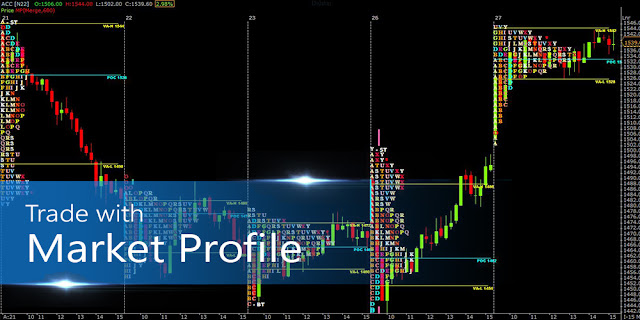
Trade with Market Profile

Trade with Market Profile


Trade with Market Profile

Trading is a continuous learning experience. Market Profile is one of the best tool to organize market generated information and help in spotting Intraday and positional trading opportunities. Market Profile is not a time-based chart rather it organized the Trading Data and charts the relative frequency of trading at various price levels.  By organizing the trading data in terms of Alphabets (TPO) one can Study the Market structure and market dynamics. The structure depicted by the Market Profile reflects market-generated information; it represents the actual buy and sell orders transacted in the market place.
Let’s look at the important concepts of Market Profile

1. TPO 

TPO

TPO or Time Price Opportunity is the basic building block of Market Profile. Each and every letter in the chart represents a TPO. Which in turn represents a point of time where the market touches a price. Each consecutive letter generally denotes a 30min period of Market Activity.

2. Initial Balance (IB)

Initial Balance (IB

Initial Balance represents the first hour of trade. Typically the high and low range of the letters ‘A’ & ‘B’. Longer the length of the Initial Balance stronger the conviction of Long term and Short term players. It’s generally the first 60-mins of trading sets the tone of the day and gives us an upper and lower price range to use as a reference point for the day

3. POC

The price that recorded the highest trading activity.

4. Value Area

The Value Area represents the range of prices that contain 70% of a day’s trading activity.

5. Value Area High (VAH)

The upper level of the value area.

6. Value Area Low (VAL)

The lower level of the value area.
When there is a series of single tail letters above VaH & VaL, it is called as a single print buying &selling tail respectively. This kind of tail represents a strong reaction by the Other time frame trader(OTF).