Showing posts with label Market Analysis Software. Show all posts
What is Volume Profile & How does it works?

What is Volume Profile & How does it works?


What is Volume Profile

What is Volume Profile?

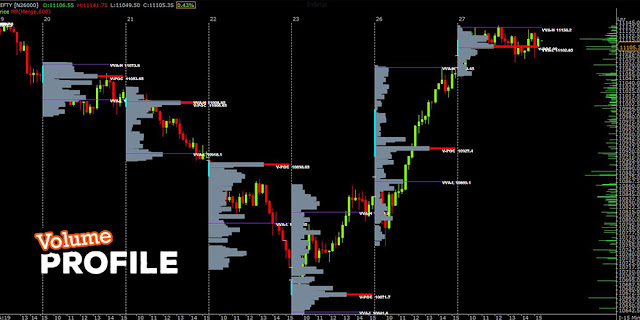
Volume Profile is a visual representation of how much volume occurs at each individual price over a certain period of time. It helps traders to identify support and resistance. By looking at the volume we can see where the most activity is taking place historically.

The important ingredients of Volume Profile include:-

·         Value area: The Value Area represents the range of volume that contains 70% of a day’s trading activity. Prices in value areas are the most acceptable prices.
·         Initial Balance: Initial Balance represents the first hour of trade to predict how the market will perform during the rest of the day or to identify volatility to avoid trading.
·         VPOC: The price that recorded the highest trading activity.
·         Value Area High (VAH): The upper level of the value area.
·         Value Area Low (VAL): The lower level of the value area.
This is used to identify Support and Resistance. Volume The profile also includes High volume nodes (HVNs) where prices are deemed as fair prices. These are the prices where traders spend most of their time. HVN attract market activity. In contrast to HVNs, where prices are deemed as unfair prices are known as Low volume nodes ( LVNs), at these prices, traders spent no or little time. LVN tends to reject market activity.

How does volume profile works?

Basically, Volume Profile takes account of total volume traded at a particular price level during the specific duration and divides the total volume into either “buy volume” or “sell volume”. This makes easier for the trader to understand the information.

How to find Support and Resistance?

The first and most important use of the Volume profile is to find basic support and resistance levels. It is a reactive method to identify support and resistance. This means the method relies on past price movements and volume behavior unlike proactive methods (such as trend lines and moving averages) which are based on current price action and analysis to predict future price movements.
It can also be helpful in applying meaning to price levels where the market has visited earlier.

Bottom Line

Volume Profile is an exceptionally valuable tool for Technical Analysis for the traders. It is a charting tool that does a variety of things that are helpful while trading
The data that is provided by Volume Profile is quite certain. While in its simplest form, it is a great reactive method for analyzing and finding traditional support and resistance areas. It is capable of comparing a real-time event (the current day’s open) with historical events (the previous day’s profile) and make the best decision based on the connection of the two.

Beginners’ Checklist for Stock Market

Beginners’ Checklist for Stock Market


Beginners’ Checklist for Stock Market

Let us begin with a very simple question – What comes to your mind when you say the word “Stock Market”?
List of most common terms include-
·         Profit and Loss
·         Money
·         Bear
·         Bulls and many more
However, this mere list of words does not constitute the stock market. The stock market is much more than that. Here is a Beginners’ Checklist for Stock Market that will help you understand the functioning of the market.

What is the Stock Market?


What is the Stock Market?

It is a mechanism where the shares of publicly traded companies are bought, sold and issued. It is one of the most important parts of the free market economy.
So, how does this market work?
The prices of the shares in the market depend upon several factors. If we understand it in simpler words, when the number of buyers is more than that of sellers then prices of shares will go up.
Likewise, if the number of sellers exceeds the number of buyers, the prices of the shares will go down.
Given the fact that we are now clear with the basics, let us now discuss what all needs to be kept in mind by beginners who are planning to invest in the stock market.

1. Set Long-term Goals Patiently


There are three things which decide your wealth in the long-term. These include investment capital, net annual earnings, and the number of investment years.
For those of you who are beginning to take a plunge in the market, you should be clear when it comes to your financial needs.
You should set the purpose and period of funding clearly right from the beginning.

2. Decide on your Risk Tolerance

Decide on your Risk Tolerance
Risk Tolerance basically means how you feel about risks and the degree of anxiety you go through when risk is present.
You should understand your risk tolerance and then make an investment. This way, you can avoid the investments which will certainly make you anxious.
It is important to note that you should never own any kind of assets which can keep you from sleeping peacefully at night.

3. Read Good Books

Read Good Books

It is rightly said that books are one’s best friend and thus according to me, the key to every knowledge in today’s date is reading.
Here are a few good books which you can start with to understand Technical Analysis.    
·         Reminiscences of a Stock Operator (Edwin Lefevre)
·         Trading for a Living (Alexander Elder)
·         Technical Analysis of the Financial Markets (John J Murphy)
·         Japanese Candlestick Charting Techniques (Steve Nison)
·         Encyclopedia of Chart Patterns (Thomas Bulkowski)

4. Follow Good Traders

Follow Good Traders

When you think of entering this exciting world of the stock market, you should know about the best traders in the world. Read about them, their strategies, books, etc. It will surely benefit you in a trading career in the long run.
For reference, here are a few well-known names in the industry –
·         Paul Tudor Jones
·         Jack Swagger
·         Alexander Elder
·         Martin J Pring
·         John J Murphy
On a final note, here are a few basics which you cannot ignore –

5. Financial Metrics and Definitions


P/E ratio, EPS – Earning Per Share, ROE – Return on Equity, and CAGR – Compound Annual Growth Rate.

6. Popular Methods of Stock Selection and Trading

You should understand fundamental and Technical Analysis to apply in stock market strategy.

7. Stock Market Order Types

Stock types such as market orders, limit orders, stock market order, stop-limit order, and trailing stop-loss orders.

8. Different Types of Investment Accounts

Cash accounts and Margin accounts are two accounts that form major trades. You should know the rules for each.
Once you are aware of all these things, you are good to go. However, you should remember that there’s a long way to go and as you progress you will come across new terminologies.
There is no field out there which won’t require you to know more about it.
Keep yourself updated and you’ll be good. Hopefully, this Beginners’ Checklist for Stock Market will give you a better understanding of the stock market functioning.